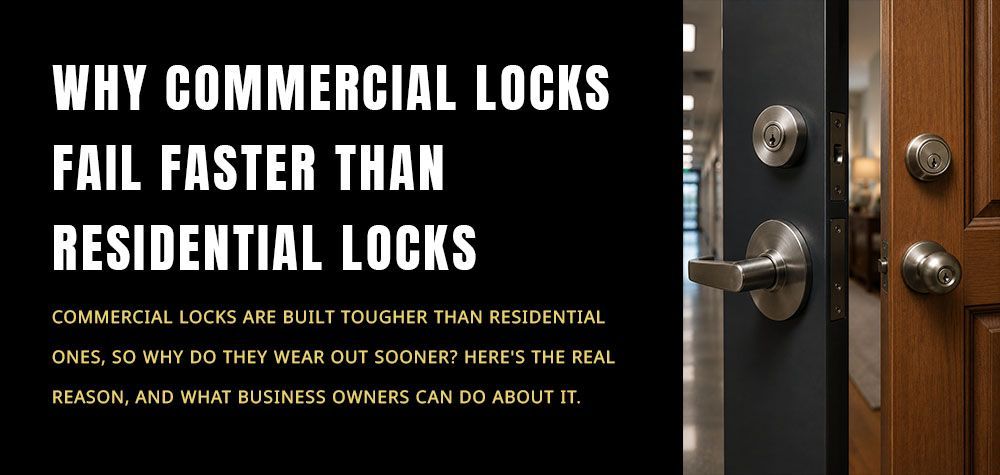
Why Office Locks Wear Out Faster Than Residential Locks
Walk into any office on a Monday morning and watch the front door for five minutes.
People walk in. People walk out. Deliveries arrive. Someone forgets their key. Someone slams the door. Someone forces the handle because they are late.
Now compare that to a home.
One family. A few entries a day. Controlled use. Predictable behavior.
That difference alone explains why office locks wear out faster than residential locks. But the real story goes deeper than just “more usage.”
If you run a business or manage a commercial property, understanding why this happens can save you from unexpected lock failures, security risks, and costly emergency repairs.
Let’s break it down properly.
What to Do If Your Smart Lock Loses WiFi Connection
High Traffic Usage Is the Biggest Reason Office Locks Fail Faster
This is the foundation of everything.
Residential locks are used a handful of times per day. Office locks can be used dozens or even hundreds of times daily.
Every single use creates friction inside the lock cylinder. Pins move. Springs compress. Metal rubs against metal.
Now multiply that by weeks, months, and years.
What looks like a sudden breakdown is actually the result of thousands of micro movements slowly wearing the lock down.
This is why commercial locks often fail earlier even if they are technically stronger than residential ones.
Why Multiple Users Damage Office Locks Faster
At home, the same people use the lock every day. They understand how it feels. They apply consistent pressure.
In an office, that consistency disappears.
Different people use the same lock in completely different ways. Some are gentle. Others are rough. Some rush. Others force the key when it resists.
Even small differences in usage habits create uneven wear inside the lock mechanism.
Over time, this inconsistency puts stress on internal components like pins and springs, causing them to wear out faster than they would in a residential setting.
Frequent Door Slamming Affects Lock Alignment
Here is something most people overlook.
In offices, doors are not just opened and closed. They are often slammed.
Every time the door shuts forcefully, the latch hits the strike plate with impact. That repeated impact slowly shifts alignment.
Once alignment is slightly off, the latch stops entering smoothly. It begins to scrape or hit the edge of the strike plate.
This creates additional resistance, which then transfers stress back into the lock mechanism.
So now the lock is not just dealing with usage. It is dealing with misalignment too.
Environmental Factors That Wear Out Commercial Locks
Office environments are much harsher on locks than residential ones.
Think about it.
Glass doors exposed to direct sunlight for hours. Metal doors expanding in heat and contracting in cooler temperatures. Constant air conditioning cycles affecting internal humidity.
These conditions cause materials to expand and contract repeatedly.
Over time, this movement affects how the lock sits within the door and frame. Even a slight shift can impact how smoothly the lock operates.
Add dust, pollution, and moisture into the mix, and the internal components start wearing out even faster.
Why Duplicate Keys Shorten Lock Lifespan
In homes, key duplication is limited.
In offices, it is everywhere.
Employees, managers, maintenance staff, cleaners, security teams. Everyone may have a copy of the same key.
The problem is that not all duplicate keys are perfect.
Even minor variations in key cutting can affect how the key interacts with the pins inside the lock.
Some keys may push pins slightly off alignment. Others may require more force to turn.
Over time, this inconsistent interaction accelerates wear inside the lock cylinder.
Why Some Locks Make Clicking Sounds Before Failing
Higher Security Demands Mean More Complex Lock Systems
Office locks are often more advanced than residential ones.
They may include master key systems, access control components, or high security cylinders.
While these systems improve security, they also introduce more internal components that can wear out under heavy use.
More parts mean more points of friction.
And in high traffic environments, that friction adds up quickly.
Early Signs Your Office Lock Is Wearing Out
Locks rarely fail without warning. The signs are usually there if you know what to look for.
You might notice the key feels rough when turning. The lock may start sticking occasionally. The door may not latch as smoothly as before.
Sometimes there is a slight clicking sound inside the lock.
At first, these issues seem minor.
But in a commercial setting, they escalate quickly because of constant use.
Ignoring these early signs often leads to complete lock failure, sometimes during peak hours when you least expect it.
How to Prevent Office Lock Wear and Extend Lifespan
The good news is that faster wear does not mean unavoidable failure.
Office locks can last much longer with the right approach.
Regular maintenance plays a huge role. Cleaning the lock, checking alignment, and ensuring keys are in good condition can reduce unnecessary stress on the mechanism.
Rekeying worn locks can also restore smooth operation without replacing the entire system.
Most importantly, addressing small issues early prevents them from turning into major problems.
When to Repair vs Replace Office Locks
Not every worn lock needs to be replaced immediately.
If the issue is minor, such as slight misalignment or early internal wear, a repair or adjustment may be enough.
However, if the lock has been heavily used for years or shows consistent failure signs, replacement is often the better long term solution.
Upgrading to commercial grade locks designed for high traffic can significantly improve durability.
A professional evaluation helps determine the most cost effective and secure option.
Experts at Brothers Locksmith specialize in commercial lock systems and can quickly assess whether your locks need repair, rekeying, or full replacement.
Final Thoughts: Office Locks Do Not Fail Faster by Accident
Office locks wear out faster because they are pushed harder every single day.
More usage. More people. More force. More environmental stress.
It is not bad luck. It is simply how these systems respond to constant demand.
The key is not to avoid wear completely. That is impossible.
The key is to manage it.
With proper maintenance, early detection, and the right professional support, you can extend the life of your locks and avoid sudden failures that disrupt your business.
Because in a workplace, even something as small as a lock can have a big impact on how smoothly everything runs.
Call Us Any Time!