Signs Your Business Security Needs an Upgrade
Most businesses don't wake up one day and decide it's time to overhaul their security, it usually creeps up on them. A lock that's been sticking for months, an old employee's key that was never returned, an alarm code that half the neighborhood probably knows by now. None of it feels urgent in isolation, but together these small things tend to paint a fairly clear picture of a security setup that's fallen behind where the business actually is now.
Why Commercial Locks Fail Faster Than Residential Locks
You've Outgrown Your Original Setup
Whatever security you had when you first opened was sized for that business, fewer employees, fewer entry points, maybe a single storefront instead of the two or three locations you're running now. If you've expanded, added staff, or started keeping more valuable inventory or equipment on-site, and your locks and access control haven't changed since day one, that gap is worth closing before it becomes a problem rather than after.
You Genuinely Don't Know Who Has a Key
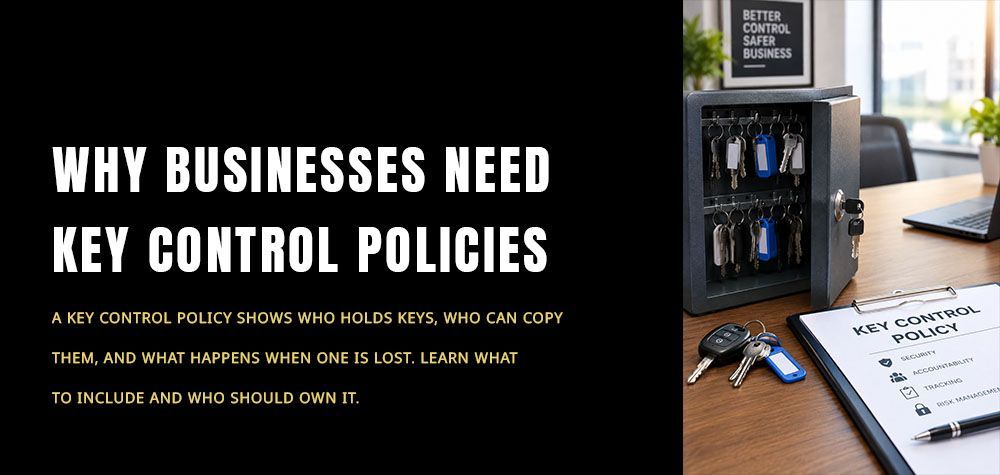
This is one of the clearest signals, and it's more common than most business owners like to admit. Keys get handed out to employees, contractors, cleaning crews, and long-gone staff over the years, and without a clear system, it becomes almost impossible to know exactly how many copies exist. If someone asked you right now how many keys to your business are out there, and you genuinely couldn't answer, that's your sign.
Locks Are Original to the Building
Commercial buildings often come with whatever locks the landlord or previous tenant installed, which may have nothing to do with your actual security needs. Standard, builder-grade hardware is a common weak point, not because it's necessarily bad, but because it was never chosen with your specific business, inventory, or risk level in mind.
You've Had Any Break-In Attempt, Successful or Not
An attempted break-in, even one that didn't succeed, is information. It tells you that your current setup was tested and either held or didn't. Treating a failed attempt as a non-event, rather than a signal to reinforce whatever was targeted, is a common mistake, the same weak point is often tried again.
Employee Turnover Has Been High or Recent
Every employee who's had a key or an access code and then left the company represents a small, lingering security gap unless it's actively closed. This adds up faster than most owners track, especially in businesses with regular seasonal hiring or higher turnover roles. If it's been a while since your last rekey relative to your staffing changes, that gap has likely grown larger than you'd expect.
You're Still Relying Entirely on Physical Keys
Physical keys aren't inherently a problem, but for businesses with multiple employees or shifts, they come with a built-in limitation, once a key is out there, you have no way to track its use or revoke it individually without changing the whole lock. If you're managing a team and still handing out identical keys to everyone, it's worth evaluating whether access control would give you meaningfully more control.
How to Improve Security for Small Retail Stores
Your Alarm Code Feels Like "Common Knowledge"
An alarm code that's been the same for years, shared freely with anyone who's ever needed it, isn't functioning as real security anymore, it's more of a formality. Security that everyone's stopped thinking about consciously has usually stopped being much of a deterrent, too.
You Can't Say With Confidence Who Has Access to What
In a well-set-up business, you should be able to answer, without much hesitation, which employees can access which doors, rooms, or systems. If that answer is fuzzy, that ambiguity is itself the security gap, independent of whether anything has gone wrong yet.
What to Do With This List
- Take stock of what your business actually looks like now, compared to when your current security was set up
- Get a clear count of active keys and credentials, even if it means starting fresh with a rekey
- Evaluate whether original, builder-grade hardware still fits your risk level
- Treat any break-in attempt as a prompt to reinforce, not just move on from
- Match your access system to your actual team size, moving toward access control if physical keys have become hard to track
How a Locksmith Can Help
A locksmith who works regularly with commercial clients can typically walk through your space, flag the highest-priority gaps, and recommend fixes that match your actual risk level and budget, rather than a blanket "replace everything" approach that isn't necessary for most small businesses. Professional commercial lock services cover exactly this kind of security review, from simple rekeying and lock upgrades to full access control and master key systems.
Frequently Asked Questions
Q: How do I know if my business needs a full security upgrade or just a few small fixes?
A: Most businesses don't need to replace everything at once. An assessment from a commercial locksmith can identify which specific gaps matter most for your situation, so you can prioritize accordingly.
Q: Is it normal for a small business to still rely on regular keys instead of access control?
A: It's common, especially for smaller teams, and traditional keys work fine for many small businesses. Access control becomes more valuable as staff size, shift count, or entry points grow.
Q: What should I do if I'm not sure how many keys to my business exist?
A: Rekeying is the most reliable fix. It renders all existing keys for that lock unusable and lets you issue a fresh, known set.
Q: How often should a business review its security setup?
A: There's no universal schedule, but a review after any of the signs above, high turnover, a break-in attempt, or simply not having looked at it in years, is a reasonable trigger.
Q: Does upgrading business security have to be expensive?
A: Not necessarily. Many of the highest-impact fixes, like rekeying or reinforcing a specific door, are relatively affordable. A locksmith can help prioritize based on your budget.
Final Thoughts on Recognizing an Outdated Setup
None of the signs above, on their own, mean disaster is imminent. But recognizing two or three of them in your own business is a reasonable prompt to get an actual assessment rather than waiting for an incident to force the issue. Security that quietly fell behind is far easier to fix proactively than after it's already been tested.
Call Us Any Time!